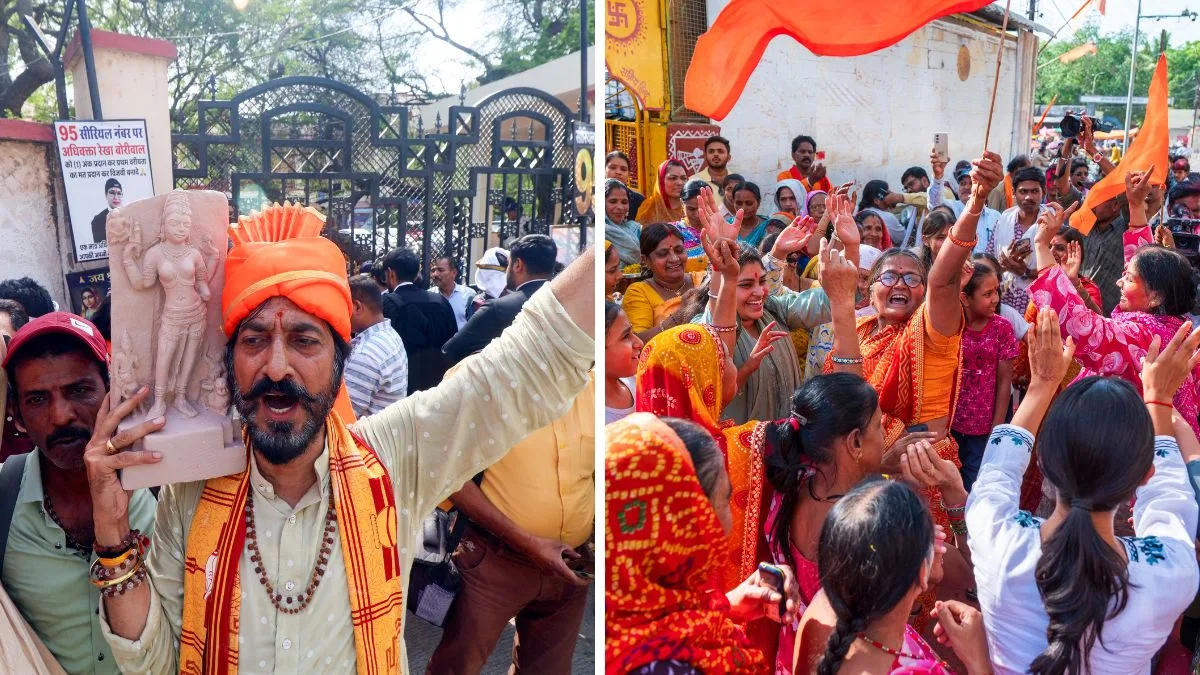
Devotees gathered at the Bhojshala complex in Madhya Pradesh’s Dhar on Saturday to offer prayers and recite the Hanuman Chalisa, a day after the Indore Bench of the Madhya Pradesh High Court recognised the disputed site as a temple dedicated to Goddess Vagdevi Saraswati and granted the Hindu side the right to worship there.
The verdict has altered a decades-old arrangement at the Bhojshala-Kamal Maula complex, where religious access had remained contested and regulated under administrative orders. While Hindu groups called it the outcome of a long struggle, Muslim organisations and leaders raised concerns over minority rights, religious freedom and the wider impact on India’s secular framework.
Advertisement
Members of the Bhoj Utsav Samiti joined devotees at the complex on Saturday morning for a puja conducted as per Vedic rituals. Flowers were offered at the shrine of Goddess Vagdevi and the Yagya Kund, as security remained tight around the site.
Ashok Kumar Jain of the Bhoj Utsav Samiti welcomed the ruling, saying the “long-standing battle” had finally borne fruit.
“Our long-standing battle bore fruit today, and we call on the Hindu society to come and offer prayers,” Jain told ANI.
Jain alleged that restrictions on Hindu worship were imposed during the tenure of former Madhya Pradesh Chief Minister Digvijaya Singh.
“We used to offer prayers here every Tuesday, but the Congress state government under Digvijay Singh put restrictions on us and allowed us only once a year on Basant Panchami, while giving the rights to offer Namaz to the Muslims,” he said.
He also referred to earlier protests over the issue, claiming that three workers had died during the agitation.
“We protested and did Satyagraha, during which three of our workers died as well… The workers did not back down, and finally, the government had to bow. Hindus were given the right to worship every Tuesday on April 8, 2003,” Jain said.
What the High Court said on Bhojshala
The Madhya Pradesh High Court ruled on Friday that the religious character of the Bhojshala-Kamal Maula complex was that of Bhojshala, a temple dedicated to Goddess Vagdevi, dating back to the Bhoj-Parmar dynasty.
The court also partially set aside the Archaeological Survey of India’s April 7, 2003, order, which had allowed the Muslim community to offer Namaz at the site on Fridays.
ASI lawyer Aviral Vikas Khare said the complex would continue to remain a protected monument under the supervision of the Archaeological Survey of India.
“The entire administration and regulation of this monument shall remain exclusively with the ASI,” Khare said.
Advocate Vishnu Shankar Jain, representing the Hindu side, described the judgment as “historic” and said the court had recognised the complex as belonging to Raja Bhoj. He also said the court had addressed the demand for bringing back the idol of Goddess Saraswati, currently housed in a museum in London.
“The Indore High Court has delivered a historic verdict, partially setting aside the ASI’s order dated April 7, 2003. Furthermore, the Court has granted the Hindu side the right to worship and has recognised the Bhojshala complex as belonging to Raja Bhoj,” Jain said.
JIH, Owaisi question verdict
The ruling also drew sharp criticism from Jamaat-e-Islami Hind and AIMIM chief Asaduddin Owaisi.
Jamaat-e-Islami Hind president Syed Sadatullah Husaini said the judgment raised serious concerns linked to the credibility of the judicial system, minority rights, religious freedom, communal harmony and the secular fabric of the country.
“The removal of established worship rights of one community in favour of another not only disrupts a long-standing arrangement but also risks undermining the principle of equal respect for all faiths,” Husaini said.
He also criticised the suggestion of alternative land for the Muslim community, saying religious rights could not be treated only as a matter of physical space or relocation.
“Religious rights cannot be reduced to questions of mere physical space or relocation, as places of worship are deeply connected with historical continuity, identity, and collective memory,” he said.
Owaisi, meanwhile, said the verdict did not align with constitutional values and compared it with the Babri Masjid-Ram Mandir dispute.
“This judgment does not align with constitutional values. The verdict delivered regarding the Babri Masjid-Ram Mandir dispute accorded primacy to a single religion while effectively undermining the worship rights of others,” Owaisi said.
Security tightened in Dhar
The district and police administration conducted a flag march on major roads in Dhar on Friday to maintain law and order. Police deployment continued on Saturday as devotees visited the complex.
District officials are monitoring the situation through executive magistrates and digital surveillance to prevent any disruption.
Two caveat petitions have also been filed in the Supreme Court, anticipating a possible challenge to the High Court verdict by the Muslim side.